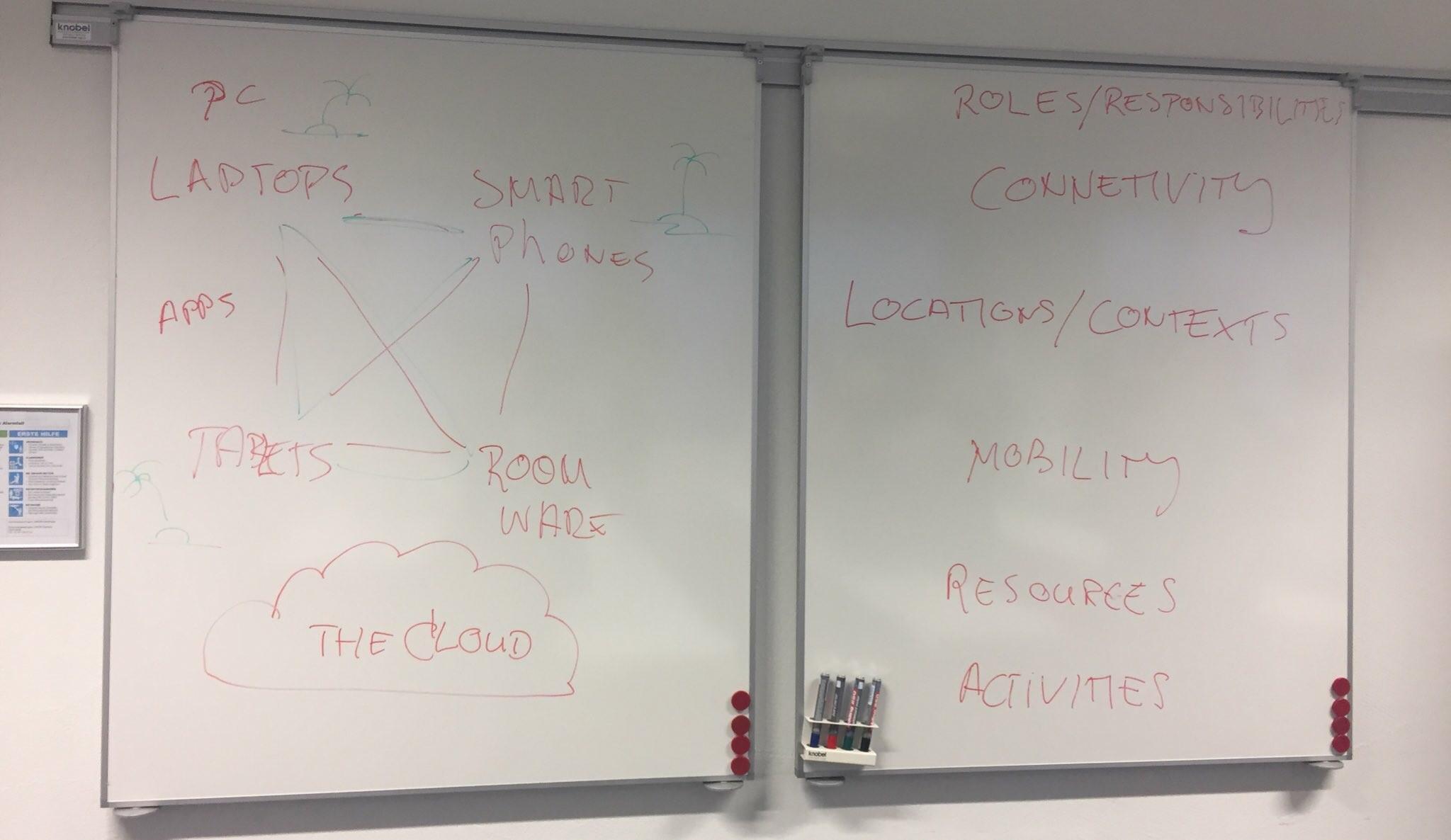
Kick-off meeting of the Swiss Mobile Learning SIG

Mobile learning is one of the hottest topics currently in education. At the same time, mobile learning is one of the latest trends in educational technologies. Therefore is the development of best practice networks is critical to support both researchers and practitioners in the field.The ELK-Team of the Faculty of Humanities at the University of Zürich has taken the initiative to organise a kick-off meeting for a Swiss mobile learning SIG. This Special Interest Group invites researchers and practitioners who work with mobile technologies in education and training in Switzerland. Currently, there is a poll for the exact date. Below you find the exact details of the invitation.

Printed books on the decline

Over the past 12 months we have seen many new tablets and e-book readers appear on the market. Remarkably, since the launch of the iPad three years ago, also other and older e-book reading devices seem to benefit from the technology hype around apples product. What appears to be smart marketing trick of the late Steve Jobs, could also be part of a much larger change of accessing text information in the information society. Today, I found a nice visualisation of some statistics about reading preferences of American students on Schools.com

mLearn 2012 - Call for Workshops and Tutorial

Being Workshops chair of the mLearn 2012 conference in Helsinki, it is my duty to distribute the call for submissions. We are looking for hot topic workshops on mobile technologies in the wider context of learning, education and training, ubiquitous technologies for learning and m-commerce. Today I have finalised the call for the workshop and tutorial submissions and made it available to the public.

Meet me at Learning in Context in Brussels.

The STELLAR Network of Excellence and CELSTEC organise the workshop Learning in Context on 26 and 27 March in Brussels. This workshop is aligned with the third grand challenge of Technology enhanced learning of STELLAR. I have been invited to present my recent work on mobile learning for security and defence organisations at the ISN.

Go and register for the event if you want to learn about the challenges of mobile learning in the security and defence sector.

Publications on Mobile Learning


Currently, I am conducting a broad analysis of contemporary mobile learning research. I was looking forward to this exercise because I wanted to contextualize the results of our concept mapping study with ongoing research. In this post I list a few high-level views on the mobile learning research based on statistics reported by Thompson's ISI Web of Science.  A side objective of my research is to identify specific developments in Africa and South America, so don't be surprised to find references to this region.


Results of the UNESCO Mobile Learning Week Published

A few weeks ago the mobile learning week was held at the UNESCO headquarters in Paris. A couple of days ago the report of the results of the weeks have been published online. The report emphasizes the "access to education for all" theme of mobile learning. Certainly, this is one of the key challenges that mobile technologies can help. It is interesting that as a response to this focus, the main criticism and concerns mentioned in the report were of the types "technological limitations" or "organisational limitations" (from a teachers perspective). 

It would be really interesting to have a concept mapping study on the statements collected from this event and compare the results to our previous expert study

When did mobile learning start?

Today I came across an interesting posting in a mobile learning forum on XING. The thread started with the question "When did mobile learning really start?". There was already a posting that claimed that Nokia started the mobile learning idea in 2001. I thought, "wait! 2001 is too late" and started some digging in my references. What I found there was interesting and enlightening. 

Google Scholar Citations

Marco Kalz pointed me at a new beta service of Google Scholar: Citations. This service collects my scientific publications into a personal portfolio. This portfolio includes all resources with my name on it  that Google finds on web-pages that are associated with research and development. Furthermore, this service also aggregates a few citation indices for me and provides a citation count per publication. The indices come in handy for benchmarking the personal performance. This is pretty awesome stuff if you publish, need to track your impact, and like to get a little dose of self-esteem boost ("oh my god, yeah I did all that work").  

Interestingly Google collects publications more rigorously than I would personally do myself and includes unpublished project reports, software projects, and other stuff that I would not consider as relevant publications. The funniest thing is one paper among my most cited references that completely surpassed my radar. I definitely worked on that projects and wrote some stuff but I cannot recall that conference publication. 

Check out my Google Scholar Citations profile


Geo URI: location as a resource

Just a bit than one year ago the Internet Engineering Task Force has released the RFC5870 that specifies how references to locations have to be written in the URI scheme. This basically provides a technical standard for sharing locations in a human and machine readable way. This is extremely cool because now you  can embed references to locations in space just like you would link normal HTML documents.

This standard is an important step to move location-based services from prototypes to the mainstream. In this article I outline a few ideas how existing web-solutions can lead to new usages using this standard.  

Limitations of Awareness Support in Education and Learning

Last week the SURF Academy organised a seminar on learning analytics. Hendrik nicely twittered from the event, so I was able to follow it. After he posted a comment about measuring the performance of teachers I needed to respond. My prime criticism is that the type of analytics that he describes is not learning analytics, but pretty boring performance benchmarking and that this if done by the wrong people might has legal implications that are beyond what Hendrik and Wolfgang outlined in their presentation

I worked on the topic for several years, although I do not use the currently popular term "learning analytics" because it emphasizes the statistical procedures over the actual or potential use and usefulness of the resulting data. Instead, I prefer the term "awareness support" because it includes the purpose of how the data should be used and helps to focus on appropriate solutions. The entire topic is very new and needs some clarification. In this article I try to focus on my understanding of what "learning analytics" is about. 

© 2002-2011, Christian Glahn and Michael Valersi